
I’ve had a version of the same conversation more times than I can count. A product leader—smart, experienced, running a well-functioning team—is frustrated: retention is flat. The roadmap is full, but nothing’s moving the needle. There’s plenty of data, and everyone agrees on the direction. However, the growth they anticipated from all that effort is simply not materializing.
The problem is rarely execution quality or speed. The teams I’ve worked with are good. They have outcome frameworks, OKRs, and strong intuitions about their users. The issue is that they’re doing the right things in isolation. They are optimizing their corner of the product without a clear line of sight as to what’s happening before or after that moment in the customer’s experience. Growth doesn’t live inside a single feature. It happens across moments: onboarding, activation, issue resolution, renewal, to name a few. When those transitions are fragmented, the cost is real: churn nobody wants to own, support volume that keeps increasing despite product improvements, roadmaps where each team delivers but the whole is less than the sum of its parts.
What’s worth saying before anything else: most organizations are already managing their journeys in some shape or form. They have KPIs, they track drop-off, and they hold reviews on a regular cadence. They’re just doing it without a shared frame, which means the same friction is rediscovered by different teams, fixes are made in isolation, in one part of the experience, and the end-to-end picture never quite comes into focus. Managing journeys is not starting over; it’s making what is already happening more intentional.
Journey management can address this problem very well; while you seem to be doing everything right by the book, yet the needle still doesn’t move on real, meaningful impact. The real value of journey management isn’t another process or a workshop methodology, but a way of building shared visibility into how the full lifecycle is performing and using that to make sharper decisions about where to focus next.
Why It Makes Financial Sense to Invest in Orchestrating Journeys
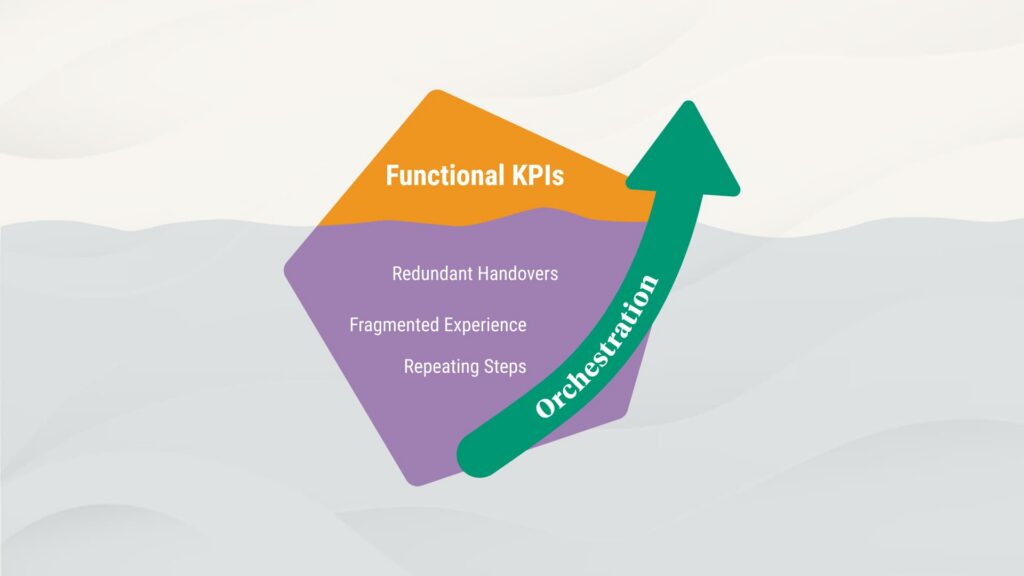
The business case is more concrete than most people expect. Journey management exposes inefficiencies that hide beneath functional KPIs (redundant handovers, unresolved friction, avoidable support volume). When product teams fix those moments, the savings land in cost-to-serve: fewer inbound contacts, shorter resolution cycles, lower support cost per user. Our team saw this dynamic clearly in a project with Cox Communications. Moving homes is one of the moments when customers naturally reconsider their service providers, making it both a churn risk and an opportunity. At Cox, the teams responsible for digital transfers, call centers, retail, and installation were each performing well individually, but the experience across those moments was fragmented. Customers often had to repeat steps between channels just to transfer or confirm their service. When the organization stepped back and examined the full moving journey end-to-end, the opportunity became clear.

By aligning teams around that journey and redesigning key moments across channels, Cox saw significant reductions in post-move churn, higher mover flow share, and the highest NPS scores for that transaction type in the company. That’s one of the most defensible ROI arguments you can put in front of a finance leader, because it’s measurable and it connects directly to the lifecycle moments your team already owns.
The data backs it up. Forrester’s Buyer’s Guide for Customer Journey Management (CJM) Platforms, based on interviews with 30 buyers across industries and maturity levels, found that organizations integrating CJM platforms with operational KPIs and financial metrics reported clearer prioritization, faster decision-making, and measurable impacts on cost, effort, and customer and company value, while those without connected data and metrics found ROI remained anecdotal and journey management stayed vulnerable in budgeting cycles. In another client collaboration, we identified one single point in the end-to-end customer journey, one small change in how they run their business that would lead to over $4M of annual savings. The fix here wasn’t complicated, but it could only be seen by taking an end-to-end view of the journey.
You Made the Business Case. Now What?
A practical note before you start building the internal case: get aligned on what you mean by journey management. The term is used in very different ways; sometimes it refers to managing CX data within a journey map tool, and sometimes it means a company-wide operating framework for decision-making. Both are legitimate, but they require different investments and different conversations. The business case you’re building needs to reflect which version you’re actually proposing, or the conversation will stall on scope before it gets to showing real value.
My advice: don’t frame this as a transformation program. Pick one journey with clear business visibility, create a baseline for its current performance, identify the cost of friction or pain at each stage, and translate that output into financial language. Reduced handling time. Lower first-year churn. Increased revenue. That proof of concept is what gets the next conversation funded, and it sidesteps the most common objection- that you need new infrastructure to get started. You usually don’t. The issue is rarely a lack of data; it’s a lack of a shared frame for reading it end-to-end.
One more thing worth saying explicitly: don’t start by mapping all your journeys or by evaluating tools. Both feel like progress, but neither is. A full mapping exercise before you have a clear business question tends to produce beautiful artifacts that don’t change any decisions. And buying a platform before you’ve established what you’re trying to manage creates a solution looking for a problem. It gives skeptics exactly the ammunition they need to dismiss the whole effort as overhead. Start with the business question. The maps and the tooling follow from that, not the other way around.
To wrap it up, remember that effective journey management starts with a clear business focus and understanding of your goals. Focus on a single journey to demonstrate value, and don’t get sidetracked by mapping everything or jumping into tool evaluations prematurely. If you’re eager to discuss this further or explore your organization’s readiness for journey management, I’m here to help. Let’s connect!
Sources:
Buyer’s Guide: Customer Journey Management Platforms, 2026 (Forrester)
