

A mandate is not a strategy.
AI has supercharged executives’ relentless desire to accelerate. Leadership says use AI, teams scramble to find applications, and suddenly, you’ve got solutions looking for problems. When organizations treat AI adoption as a checkbox and pair it with moving fast and breaking things, two questions get lost in the seductive race for speed: Is this solution worth building at all? And even if it is, does it cohere with everything else we’re building?
These technology-first approaches have always created experiential fragmentation, operational waste, and lower adoption. The stakes with AI are more consequential. At best, organizations risk confusing pure speed with real value. At worst, they break people and cause irreversible damage.
This dynamic demands slowing down enough to ensure solutions have a purpose, clear value, and take human needs and impact into account. In this piece, I offer a reminder of how history rhymes even when it does not repeat, a review of the design fundamentals for this moment, and a practical framework for ensuring value and coherence get delivered when AI-first drives the agenda.
The Fragmentation Risk
Let’s look at a historical analogue to this moment: the rise of the commercial web and the microsite. In the first decade of this century, as the web was between Web 1.0 and the social media age, it became easier to deploy websites without as much IT support. One result: marketing departments engaged external agencies to build an ocean of microsites. Each touchpoint solved a local problem based on a siloed sub-brand brief, often at the expense of its fit with people, the brand, technology, and other systems. When you zoomed out, fragmentation, incoherence, and poor outcomes became clearly visible.
I continue to have flashbacks to that era. I saw the waste of time, talent, and money. I felt, at times, hopeless about stopping the proliferation of touchpoints, even as I was hired to bring coherence to it. As a designer, I worked hard to return the focus to value and experience, not aggressive building or activity over outcomes. As an employee and customer myself, I experienced the same fragmentation. It was frustrating.
The rush to deploy AI across as many solutions follows this “we can build it” and ‘it must be fast” mentality. Not only is the value of each new solution questionable, but the sheer volume of change also deepens experiential and operational discord (and requires a lot of tokens to boot). This isn’t just a customer experience problem; it’s an organizational coherence problem. Product, CX, technology, and brand all have stakes in where AI goes. When those functions aren’t aligned around a shared understanding of what a solution is trying to do and for whom, the result is a landscape of point solutions that contradict each other, confuse customers and employees, and erode the relationships organizations are trying to build.
Poorly framed mandates drive technology-first action. Strategic mandates center on value and consider how solutions fit into or change the contexts in which businesses and people operate.
Returning to Fundamentals
A service design mindset and practice can help avoid deficiencies in value and coherence. Our methods support moving up and down scales of a system, identifying where local solutions create incoherent experiences when linked together in an actual customer journey, where interactions that seem good in the moment reveal gaps, inconsistencies, and broken promises across time and space. A little service design goes a long way.
Three principles stand out to ensure greater value and coherent services front and backstage while leveraging and embracing new capabilities, including technology, as they emerge.
Shape the Material to People, Not the Other Way Around
In the 1950s, Henry Dreyfuss argued that “for the industrial designer, the job is already assigned; to fit the new machines and materials…to people.” His point of view was partly pragmatic—it’s easier to change technology than people. With the new material of AI, the stakes are far greater, but the designer’s job remains the same. We don’t bend people to fit the technology. We shape the technology to serve people’s actual needs, behaviors, and contexts. When organizations lead with AI as the solution, they’re doing the opposite. They’re asking people to adapt to the technology rather than asking what the technology should do for the people it’s meant to serve.
Zoom Out and See the Larger Context
In 1968, Charles and Ray Eames made a short film for IBM called Powers of Ten. It starts with a couple on a picnic blanket in Chicago and zooms out—one power of ten every ten seconds—all the way to the edge of the known universe. Then it zooms back in. The point wasn’t just about scale. It was about context. What you see depends entirely on where you’re standing. When someone brings you an AI solution, zoom out one X. Where does this actually sit in the customer’s journey? What larger moments does it touch? What brand principles does it need to honor? What systems does it interact with? A solution that makes perfect sense in isolation often creates friction or contradiction when you zoom out and see it in context.
Center the Value Exchange
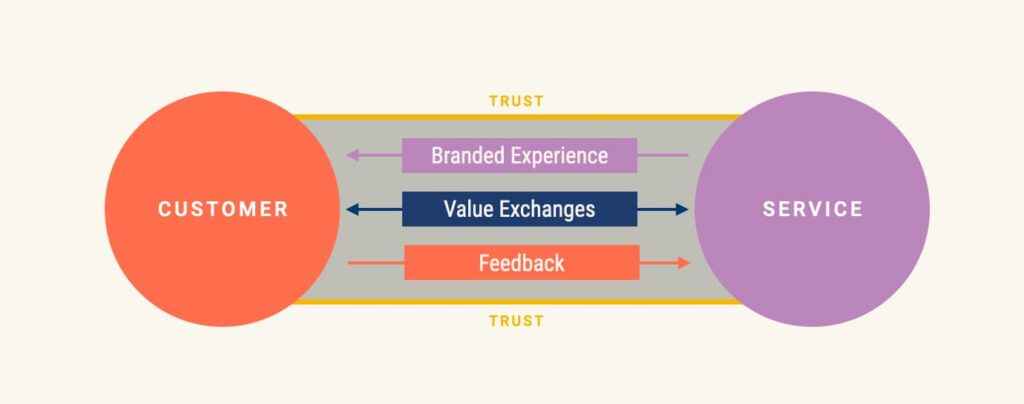
The success of any service depends upon a healthy value exchange. The service provider seeks viability in the short and long term based on its objectives, profit, or mission. The customer seeks something in return, such as functionality, insight, efficiency, or peace of mind. These value exchanges occur in small and large interactions over time (see Fig. 1).
Regardless of whether the interface to the service is digital or human, the real design work never wavers from crafting these explicit exchanges. While people are learning to design with AI material, this principle should remain the highest priority. But too many AI-driven implementations focus on the how of the build versus the why and the what of the service. It’s critical to focus on value exchanges and shape AI to create them, versus letting AI shape the service.
Embracing these principles—shape technology to people, zoom out to see context, and center on the value exchange—allows you to be “yes, and” to AI while staying focused on serving people and creating real value.
The Intelligent Experience Canvas
Here’s what leveraging these principles looks like in practice. My colleagues and I have developed the Intelligent Experience Framework (Fig. 2). Deceptively simple, this framework addresses the tendency to run with AI solutions quickly, only to find they create an underwhelming or damaging impact once built. Given people’s mental models of AI are still forming and AI solutions can be costly to maintain, this framework does the hard work of nudging the enthusiasm for AI towards an intentional focus on value and experience. One form of this framework is a canvas designed to support a conversation that moves from how to use AI to why to use AI, and how an AI solution fits into the broader experience of customers and employees.
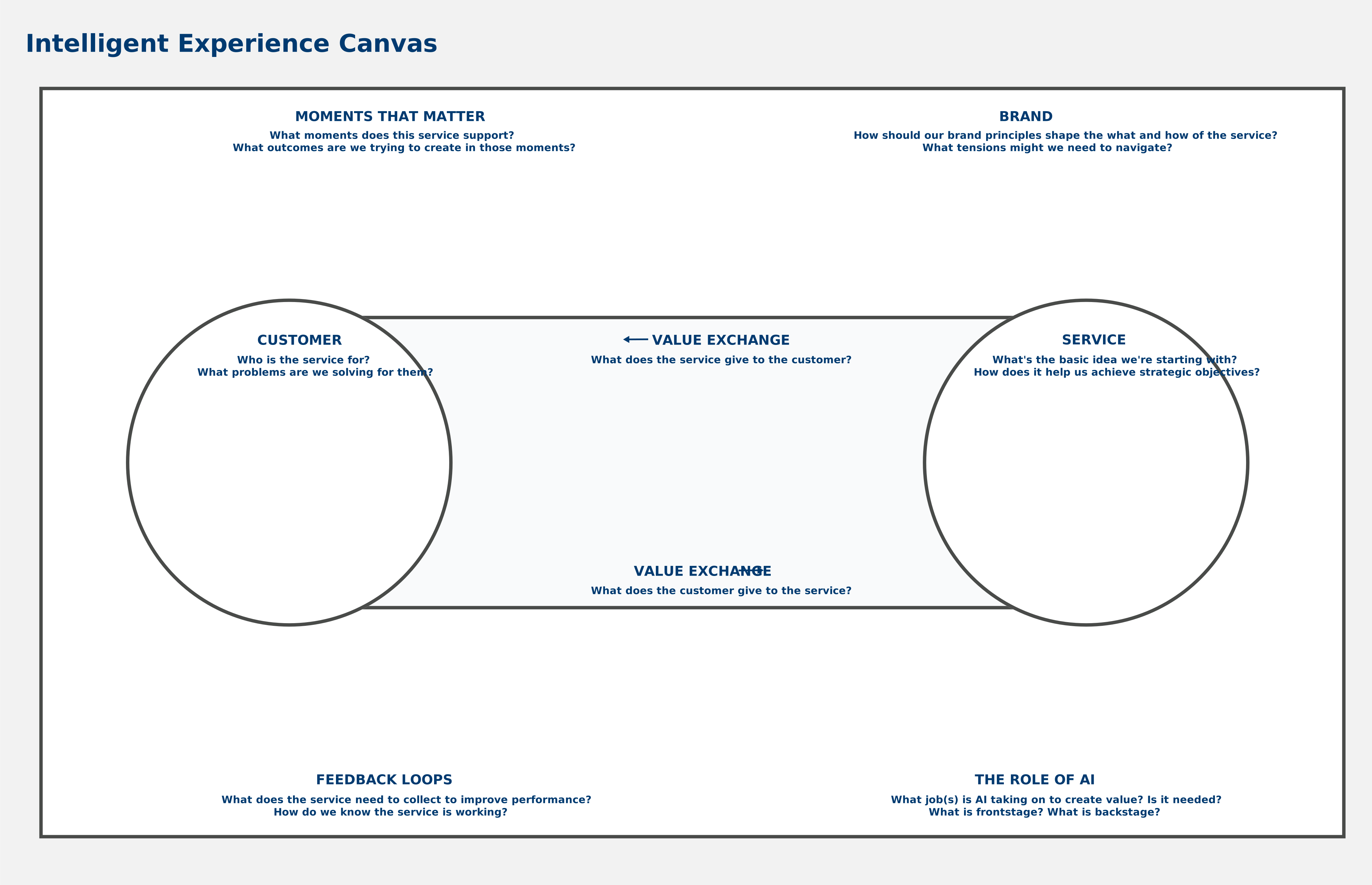
The value exchange sits at the heart of the canvas. It foregrounds the relationship between the service and the customer. On the service side, what’s the idea we’re starting with? How does it connect to strategic objectives? What service is being provided? On the customer side, which customers and problems does the service address?
The middle represents the exchange of value between the service and the customer. What does the service give to the customer? What does the customer give back—time, attention, data, trust, money? What value is created for both? Building anything valuable depends on getting this exchange right.
The areas above the value exchange represent the larger context in which this moment or offering will live in your experiential system. In the upper right, you capture the brand or experience principles that should guide the service design. A strong experiential system ensures each service reflects how your brand wants to show up and incorporates your best practices for fitting solutions into your larger customer experience. On the left, you note the moments that matter—the journeys or other frameworks that situate the service in the larger customer experience. This helps you determine which other touchpoints or moments the service should align with, thus avoiding becoming an isolated point solution and reducing fragmentation.
Below the value exchange are two equally critical areas. Feedback loops: What does the service need to collect to improve? How do we know it’s working? What are we trying to learn? With AI, special care is required. You need to know whether the service is delivering value, creating unintended consequences, and whether people trust it. The role of AI: What jobs is AI taking on to create that value? Is it needed? What is frontstage—visible to the customer—and what is backstage, working behind the scenes to orchestrate the experience?
This works best as a cross-functional conversation. Product, CX, brand, design, and technology each have a stake in different sections of the canvas. Everyone leaves the room knowing what you’re trying to solve for, what value you’re creating, how it fits within your larger experience and brand, what you’re measuring and learning, and what role AI plays.
If you already have AI implementations in flight, the canvas can also serve as a diagnostic tool. Mapping what you’ve already built against these questions often reveals gaps and what needs to be addressed before you add more.
Are you starting with AI, or starting with value?
Are your AI point solutions shaping your customer journeys, or are you doing the work to keep coherence in your system?
Try returning (or adopting) the design fundamentals and inviting your peers to slow down a moment and have the right conversations using the canvas. I’d love to hear what this does for you and your team.
