
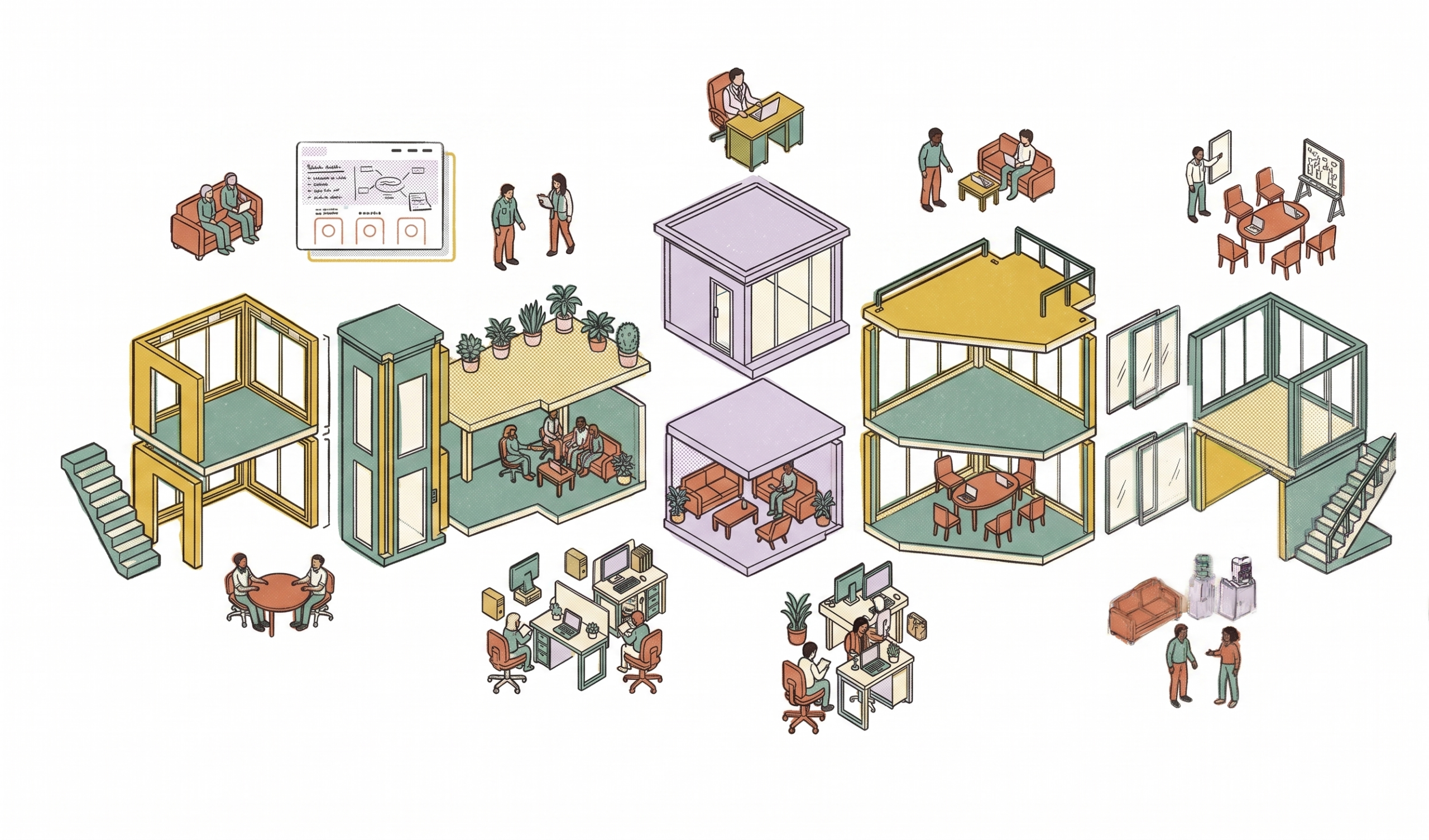
When everything works, but nothing connects.
Design is strategy made manifest
Not interpreted or layered on. Not executed downstream after decisions get made — but integrating and informing what decisions are made and why. This is strategy realized: making it tangible, testable, and true. And design, fundamentally, is about fit.
Fit top to bottom, end to end, and outside-in — spanning mental models to business models. The kind of fit that determines whether an organization works across people and teams, features and functions, moments and journeys. Everything, everywhere, all at once.
This is radical holism. Most organizations are built to optimize fit across a handful of high-visibility levels or mission-critical elements. When fit is accomplished, the win is short-lived, and it often triggers a subtle systemic breakdown of several others simultaneously. Product ships against a roadmap intended to answer the objectives leadership declared in a deck. Time keeps on ticking, and customers get to experience the gaps between all three.
The gaps are where all the action is, and nobody tends to own them. They’re nebulous and amorphous. They don’t close through formal authority, executive mandate, or any single vantage point. So organizations reach for a reorg, declare a new operating model, or commission a better strategy. The diagnosis feels right. Meanwhile, affected employees at every level do what they can to make do — or worse, subvert the change. The remedy doesn’t take hold. Classic systems rejection.
- Product shifts strategy after adopting Jobs-to-be-Done (JTBD) and journeys. The organization structure never shifts to support it, and operations scramble to fix ineffective processes.
- Executive leadership invests in cloud infrastructure capabilities. Legacy on-premise systems remain core to operations, and teams manage both.
- The organization reorganizes around customer experience. Employee incentive structures still reward individual efficiency over cross-functional outcomes.
These aren’t failures of strategy. They’re failures to design across the full scale of the challenge.
Fixing it requires leaders who can hold that scale without being overwhelmed. Leaders who work across functions without needing to own them. Who zoom between altitudes — strategic and operational — without losing the thread of either. Who create value by reconciling the fit between organizational identity, operational architecture, and human experience. Who translate between the language of business, product, and customer.
That’s not a generalist. It’s not a consultant delivering best practice. It’s a specific kind of leader doing a specific kind of work — the kind most organizations don’t have. The ones that do tend to notice the difference. Fit stops being something that happens to them and starts being something intended from the onset. Something designed.
From building features to building a movement.
This kind of fit isn’t achieved with a transformation program. It doesn’t start with a listening tour or a discovery phase either. Organizations are complex adaptive systems — more akin to the Swiss Alps than a Swiss watch. Think clouds, not clocks. No amount of careful study reveals how they’ll react to change. They’re best understood by moving through them and paying attention to what gets absorbed or rejected. Probe, sense, respond. Start somewhere real, learn what the system reveals, let that inform what comes next.
And there is always a next or a series of nexts. Change at the scope and scale required to achieve fit comes through a concerted series of campaigns sufficient to create a movement. Movements need scaffolding — just enough structure to shape, guide, and support a latticework of tactics. A way to make progress visible, keep people oriented, and give change somewhere to take root against the inevitable gravity of “the way we’ve always done it.”
Once you learn to notice the gaps, it’s hard not to. Yet, the chasm between seeing fit across organizational identity, operational architecture, and human experience and building the capacity to sustain it across shifting priorities, competing voices, and the gravity of organizational culture is vast. Over years of working inside large matrixed enterprises and small innovation teams alike, patterns emerged. The organizations that were able to make progress and sustained change weren’t honed by bleeding-edge technologies, Big 4 strategies, or bolder bets. They were the ones who’d invested in creating the conditions for common purpose, understanding, and action. From top to bottom, end to end, and outside-in. Three interlocking practices were key to creating the scaffolding necessary to steward a movement. Together, they form an operating system for designing for fit that I call the Relationship ARC.
Stewarding a Movement: Artifacts, Rituals, Commitments
The Relationship ARC creates the conditions where fit stops being accidental and becomes intentional. Not through a rigid sequence or a transformation playbook. Through a menu of reinforcing practices applied based on where the gaps actually are, what experiments reveal, and what the organization will tolerate.
Artifacts are how design makes the abstract concrete and the implied explicit. In design practice, these are boundary objects — things people can point to, react to, and build shared language around. An ecosystem map. A service blueprint. A capability model. These artifacts aren’t an output but a means to an outcome. They’re an interface to bridge perspectives across teams and functions that would otherwise be optimizing against different versions of reality. Alignment becomes possible where assumption once lived.
Rituals are the structured rhythms that let teams go deep into their own domain and come back together as shared owners of fit. Not a meeting cadence or an operating rhythm — a designed relationship between ownership and cooperation. Current norms and structures are optimized for focus and must be balanced with a reason and space for coordination. Effective rituals do both without feeling like overhead. They feel like how the work actually moves.
Commitments are how organizations wayfind under constant change. At the micro level, these are working agreements that codify the needs we’re solving for, the value we must create, and how we intend to do so. At the macro level, they become shared visions, shared purposes, and shared principles that shape action and ultimately how an organization governs itself. Not irrevocable contracts, but orientation points. Stable enough to navigate by, flexible enough to adapt as fit is achieved.
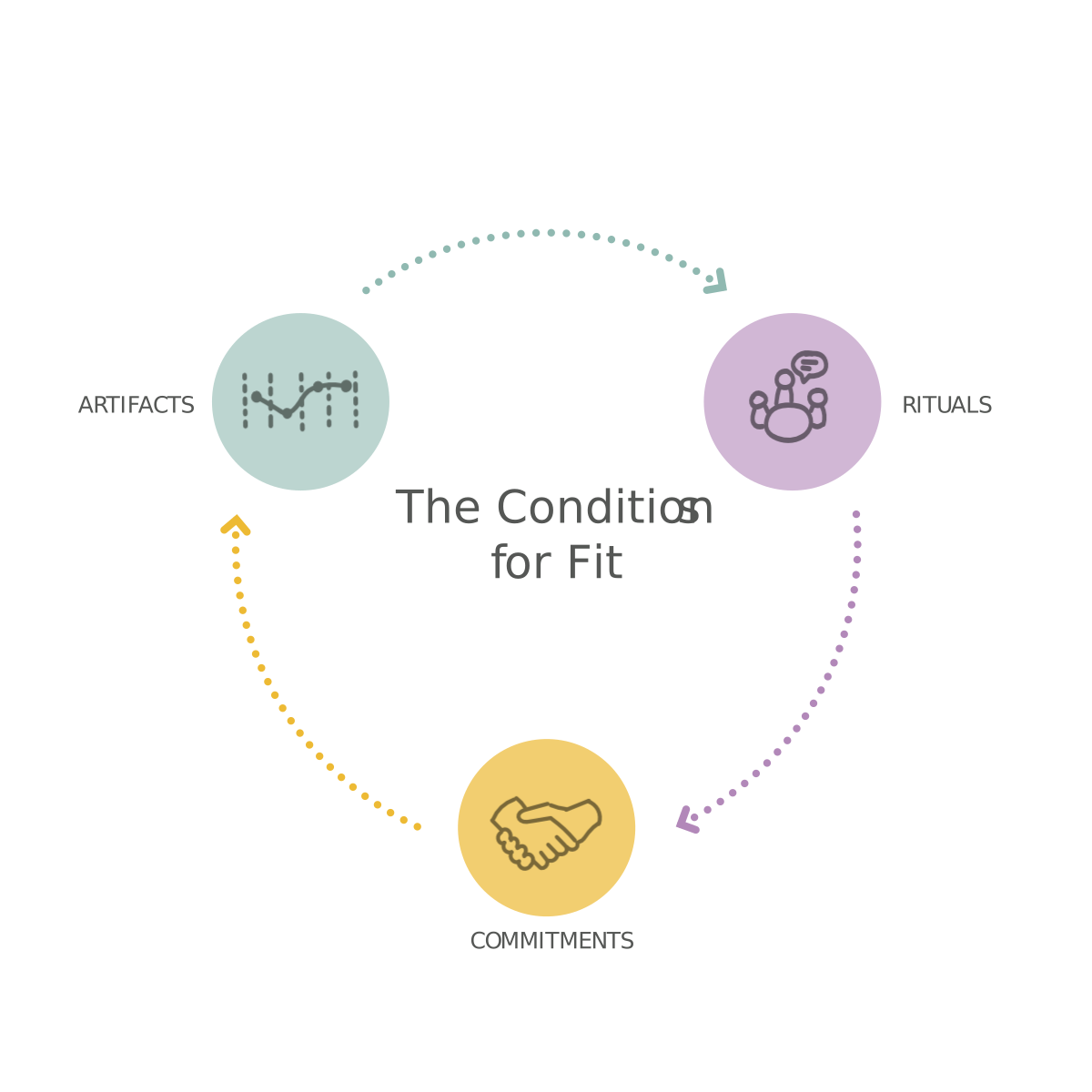
Artifacts create shared language. Rituals build the muscle of working across boundaries. Commitments hold the direction while everything else shifts. That’s the practice, the way of being, of leaders who don’t just see the gaps but know how to close them. Together, they form a virtuous circle: understanding shapes how teams coordinate, coordination reveals what commitments need tightening, clearer commitments create space for new understanding to emerge.
None of this is simple. The gaps are real, the scale is intimidating, and the grooves defining the way things are done are carved deep. Yet fit doesn’t need a perfect plan or a transformation budget or executive permission. It just requires a spark. A start. One experiment, one campaign, one relationship strengthened. Movements, by their nature, are incremental. The only question is who’s going to lead yours?