


Overview
The client faced a longstanding challenge: its irregular operations (IROP) notification system had become fragmented and inconsistent after years of organic growth. Different teams across the organization were tackling individual problems as they arose in silos, patching issues rather than addressing root causes. As a result, customers often received confusing or contradictory communications during moments of travel disruption—an experience competitors were handling better.
Recognizing the importance of clear, timely communication for building customer trust and loyalty, the client decided to make notifications a strategic priority and partnered with Harmonic Design. Together, we applied a service design approach to clarify notifications ownership, unite cross-functional teams, and map the end-to-end customer experience. The result was a holistic service blueprint and future state vision that reduced message duplication, aligned business rules, and built organizational confidence. This laid the groundwork for more consistent, empathetic communication with customers.
Outcome
New Ways of Working
The work delivered more than artifacts and recommendations—it introduced new ways of thinking and working.
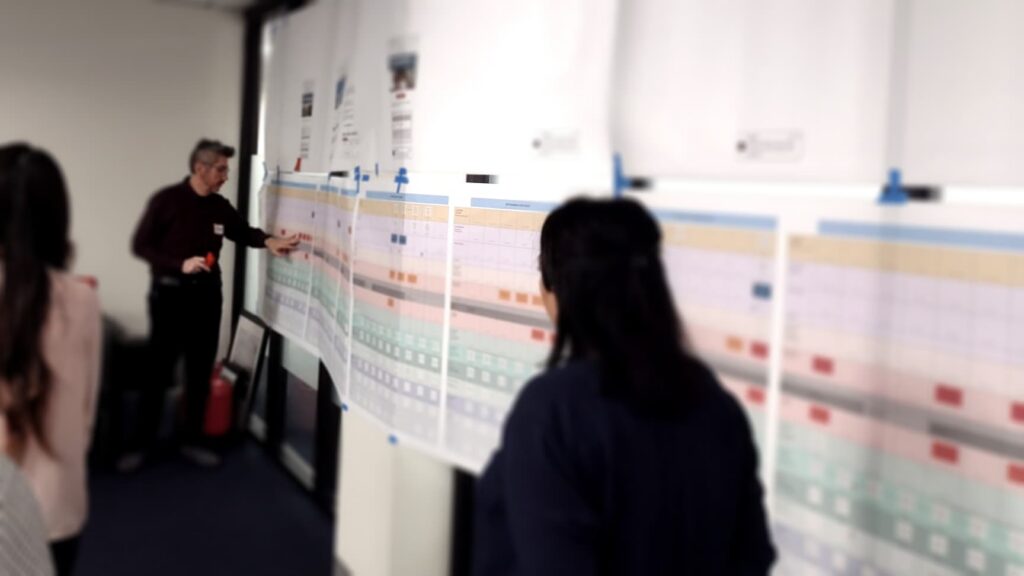
Large-scale airline operations are defined by complexity — sprawling networks, cross-functional dependencies, and thousands of daily decisions made across distributed teams. Through the development of service blueprints and architecture visuals, we brought structure to that complexity, translating it into clear artifacts that made the invisible visible. The result was an organization that could see itself more clearly, identify where friction lived, and make more confident decisions about where to focus.
That clarity created the conditions for meaningful prioritization. Rather than reacting to the loudest problems or the most recent escalation, teams gained a shared view of what mattered most and why. Focus followed, allowing teams to do fewer things with greater intention and impact.
By co-leading cross-functional working sessions, we helped bridge functions that had historically operated in silos. The blueprints and frameworks built collaboratively became a common language — one that aligned product, operations, technology, and the business around the same understanding of the experience they were collectively delivering. This shared foundation accelerated team rhythms, reduced the overhead of re-alignment, and shortened the distance between insight and action.
The engagement culminated in an end state vision that gave leadership what it needed to move with conviction. When senior stakeholders could see the full picture — how customer outcomes connected to operational realities and strategic priorities — alignment became less about consensus-building and more about execution. The organization left not just aware of its challenges, but equipped and oriented to act on them.
Testimonial:
“Seeing incredible recognition of how this is a different way of working, is giving us a lot of leverage in a lot of different places.”